
1. Crossing the Tipping Point: 2025 Was the Year of "Mass Adoption" for LiDAR
In 2025, the global automotive LiDAR industry officially crossed the tipping point from "technology validation" to "mass deployment." Once considered an expensive sensor exclusive to L4/L5 autonomous driving, LiDAR is now rapidly entering mainstream vehicles. Industry data shows that in 2025, the Chinese market saw over 3.3 million units of LiDAR factory-installed in passenger cars, a year-on-year growth of more than 120%, far exceeding expectations. The domestic LiDAR market size reached tens of billions of RMB. Globally, the automotive LiDAR market is projected to reach approximately $5.7 billion in 2026, with a CAGR of over 21% from 2020 to 2026.
Three structural drivers are behind this tipping point: on the policy side, the accelerated rollout of L3 autonomous driving regulations has opened the door for LiDAR to penetrate from high-end models to mainstream vehicles (around ¥150,000 price point); on the supply side, leading Chinese manufacturers have continuously reduced costs through chipization and vertical integration, with semi-solid-state solutions now priced in the thousand-yuan range; on the demand side, consumer acceptance of advanced driver-assistance systems (highway NOA, urban NOA) has grown rapidly, and "equipped with LiDAR" has become a key reference for consumers when choosing smart driving models.
2. Working Principle: Time-of-Flight Ranging and Coherent Detection
The core principle of LiDAR is "Time-of-Flight" (ToF) ranging: a short laser pulse is emitted toward a target, and the round-trip time is measured. The distance is calculated as R = c·Δt/2. ToF schemes are divided into direct ToF (dToF, pulsed) and indirect ToF (iToF, amplitude-modulated continuous wave). The former emits nanosecond-short pulses and uses a time-to-digital converter (TDC) to record the flight time; the latter emits amplitude-modulated continuous waves and derives distance from phase difference – FMCW (Frequency-Modulated Continuous Wave) is an advanced form of iToF that can also extract the target's radial velocity.
Compared to cameras and millimeter-wave radar, LiDAR's unique value lies in providing precise 3D point clouds (depth information) with extremely high angular resolution and anti-interference capability. It is the only sensor in the high-level autonomous driving perception layer that simultaneously meets the three key requirements of "long range + high resolution + high reliability."
3. Five Technology Roadmaps: From Mechanical Scanning to Photonic Integration
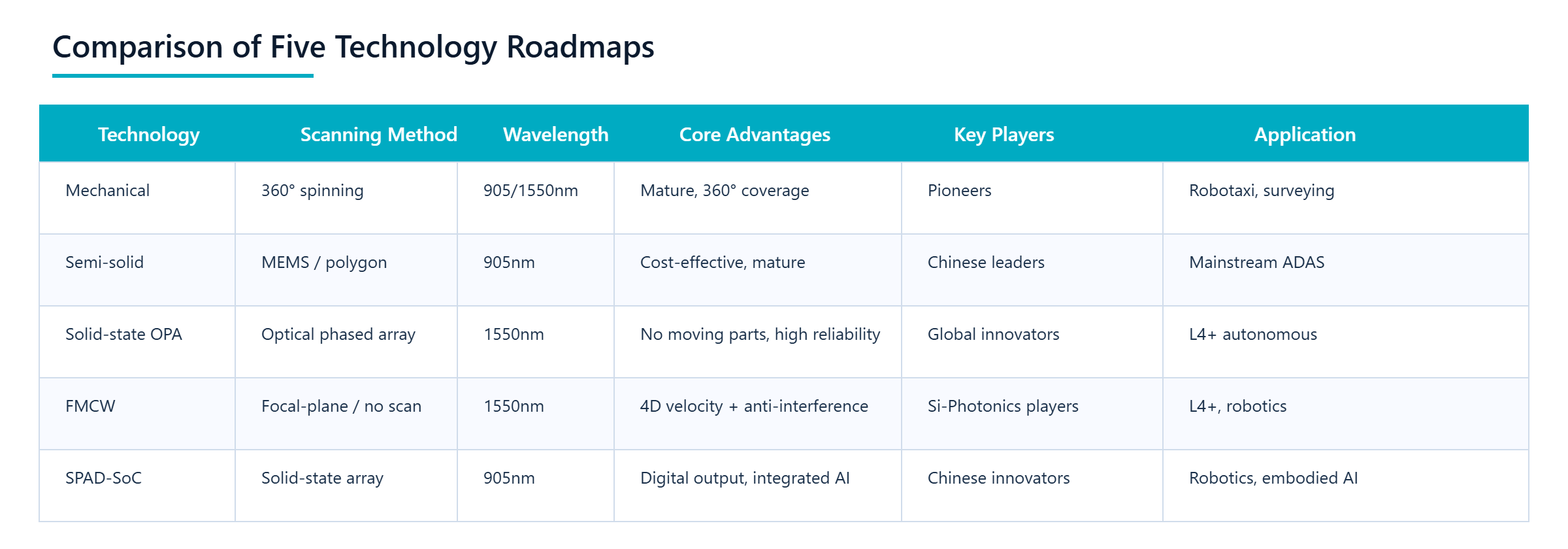
Comparison of five LiDAR technology roadmaps
Mechanical spinning LiDAR is the "original" form of LiDAR, but its size and reliability issues have hindered automotive qualification. Semi-solid solutions (MEMS / polygon mirrors) minimize moving parts and have become the mainstream choice for ADAS production vehicles, with per-unit prices now in the thousand-yuan range. Solid-state OPA (optical phased array) uses electronic scanning with no moving parts, offering extremely high reliability, but manufacturing challenges remain. FMCW (Frequency-Modulated Continuous Wave) represents a qualitative leap – using coherent detection instead of direct ToF, it improves sensitivity by 10-100× and naturally provides Doppler velocity information (4D perception), enabling solutions for critical scenarios like "door-opening" or "ghost-pilot" hazards. The SPAD-SoC (Single-Photon Avalanche Diode System-on-Chip) route embodies a new paradigm of "optical-computing integration," integrating detector arrays with TDC and AI processing cores on a single chip, delivering digital depth output at extremely low cost and high integration – ideal for robotics applications.
4. Competitive Landscape: China Leads Globally, Robotics Becomes the Second Growth Curve
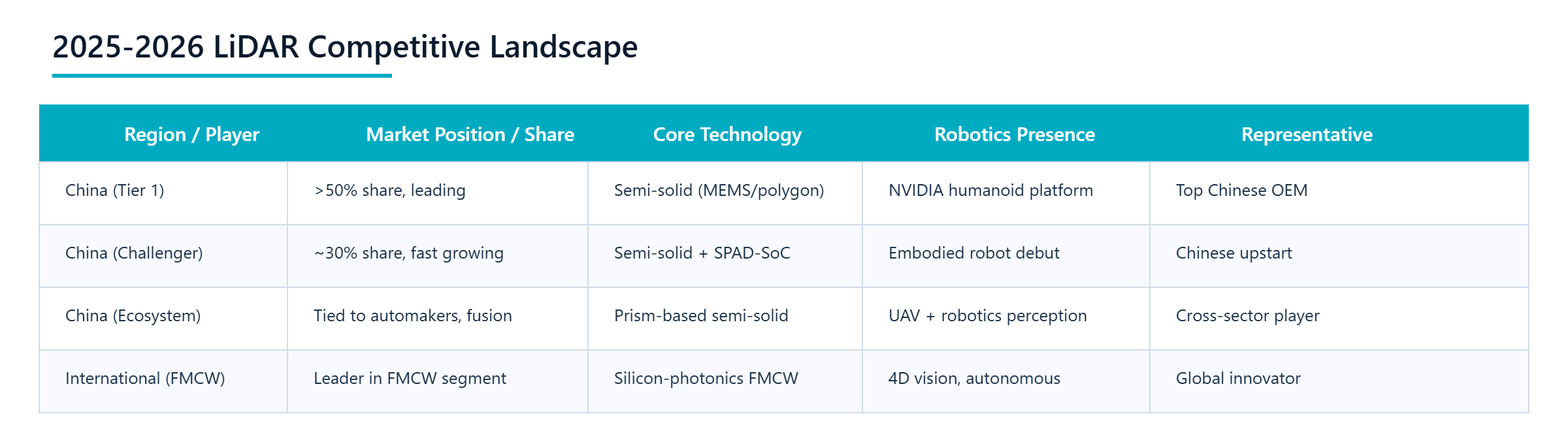
2025-2026 LiDAR competitive landscape (regional and technological)
Chinese manufacturers have taken a dominant position in the global automotive LiDAR market, accounting for over 80% of the total share. Leading Chinese players have continuously reduced costs through massive production and chipization, building deep scale barriers. The most noteworthy new trend is that robotics is becoming the "second growth curve" for LiDAR. In 2025, some players saw their LiDAR shipments for robotics surpass those for automotive ADAS for the first time, marking robotics as the primary growth engine. The industrialization of embodied AI is beginning to take shape.
5. FMCW: The High Ground of Next-Generation 4D LiDAR
If today's mass-produced semi-solid LiDAR solves the problem of "whether there is depth information," then FMCW LiDAR addresses the question of "whether I know which direction it is moving." The key advantages of FMCW are: Doppler velocity measurement (direct measurement of radial velocity with accuracy as high as 0.1 m/s, requiring only 2-3 frames to determine dynamic object status); interference immunity (coherent detection ensures only signals coherent with the local oscillator are received, effectively filtering out ambient light and interference from other LiDARs); no high-reflectance expansion (avoiding "blooming" artifacts from strong reflections, resulting in cleaner imaging).
Digital coherent LiDAR can achieve detection ranges exceeding 200 meters on low-reflectivity objects (<10%). Silicon photonics integration is a key enabler for the large-scale commercialization of FMCW, allowing lasers, modulators, detectors, and waveguides to be integrated on a single chip, drastically reducing system size and cost.
6. Application Landscape: From Automotive to Robotics, Industrial, and Low-Altitude Economy
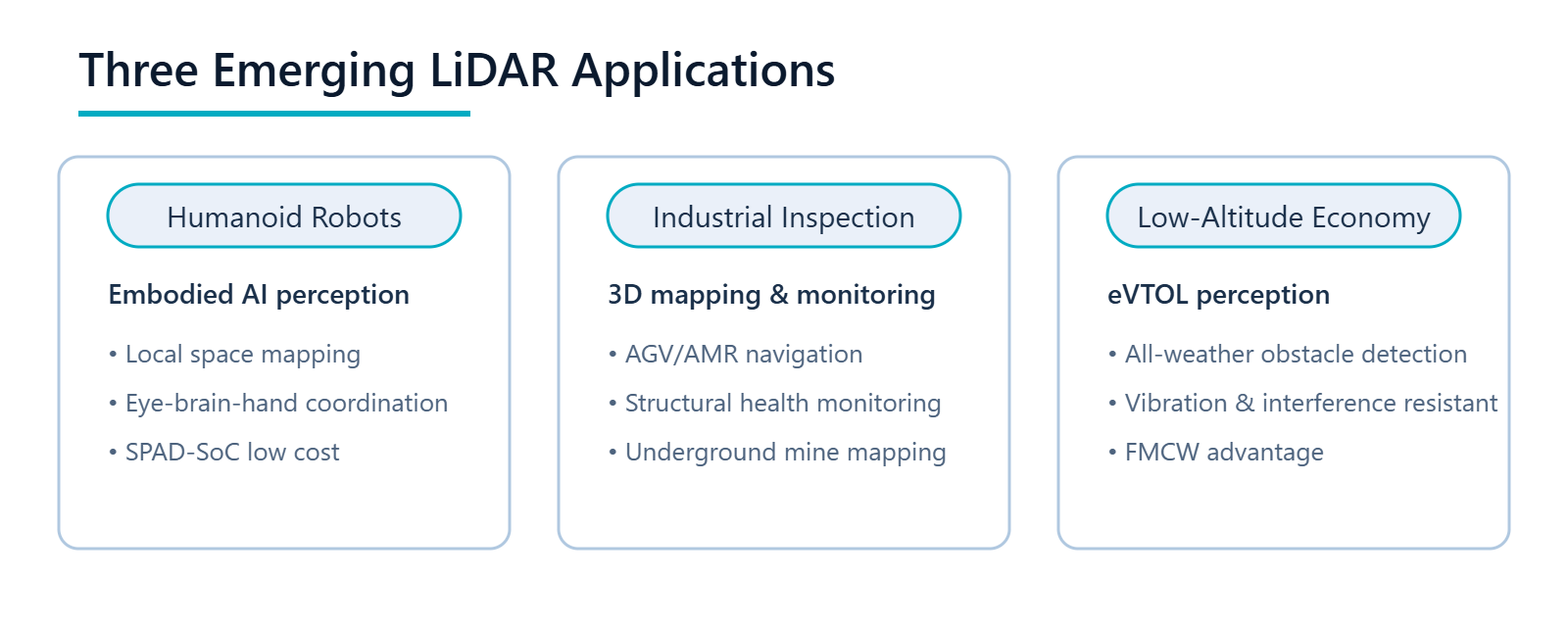
Three emerging LiDAR application scenarios
7. Summary and Outlook
The story of LiDAR is one of a technology that has gone from "niche to mainstream" and a testament to the rise of China's tech industry in global high-end manufacturing. From mechanical 64-line to solid-state arrays, from single ToF pulses to FMCW's 4D Doppler perception – every iteration pushes the boundaries of "speed and precision of light."
Looking ahead, LiDAR will evolve along three parallel paths:
FMCW adoption: As silicon photonics integration matures, FMCW LiDAR will move from proof-of-concept to mass production. Its Doppler perception and interference immunity will establish dominance in L4+ autonomous driving and eVTOL applications.
Robotics-first: Demand from robotics will soon overtake the automotive market as the largest application, driving rapid iteration of SPAD-SoC chipization.
Perception fusion: Deep integration of LiDAR with 4D imaging radar, cameras, and AI algorithms will build a more complete "perception-decision" loop, propelling high-level autonomous driving toward L3+ and full autonomy.
When a laser beam scans the world at 3×10⁸ meters per second, and when every frame of point cloud transforms from light to depth in milliseconds, the "eyes" of autonomous driving are truly opened – and at the heart of those eyes is LiDAR.