
Single-Photon Detector: The “Quantum Eye” for Capturing Photons
APD · SPAD · SiPM · SNSPD — 2026 Technology Frontier & Application Landscape
1. What is a Single-Photon Detector: The Ultimate Art of Sensing “One Photon”
A Single-Photon Detector (SPD) stands at the pinnacle of sensitivity – its mission is not to measure “strong light” but to precisely determine whether “a single photon has arrived.” This ultimate detection capability underpins quantum key distribution, quantum computing, LiDAR, fluorescence lifetime imaging, deep-space laser ranging, and many other systems.
Why is single-photon sensitivity needed?
In quantum communication, the information carrier is a single photon (each photon encodes one qubit).
In long-range LiDAR, the reflected signal from a target, after attenuation through kilometers of atmosphere, often consists of only a few or even a single photon.
In biological fluorescence imaging, faint biomarker signals also approach the single-photon level.
A conventional photodiode (PD) has a sensitivity of about 10⁵–10⁶ photons/pulse, whereas a single-photon detector pushes this threshold down to “1”.
The performance of an SPD is defined by four core metrics: Photon Detection Efficiency (PDE), Dark Count Rate (DCR), Time Jitter, and Afterpulsing Probability. These metrics often trade off against each other, forming a multi-dimensional space that requires careful balancing.
2. Four Technology Routes: APD, SPAD, SiPM, and SNSPD
Over decades, single-photon detection has evolved into four mainstream technology routes, which can be classified into semiconductor avalanche types and superconducting types based on their physical mechanisms.
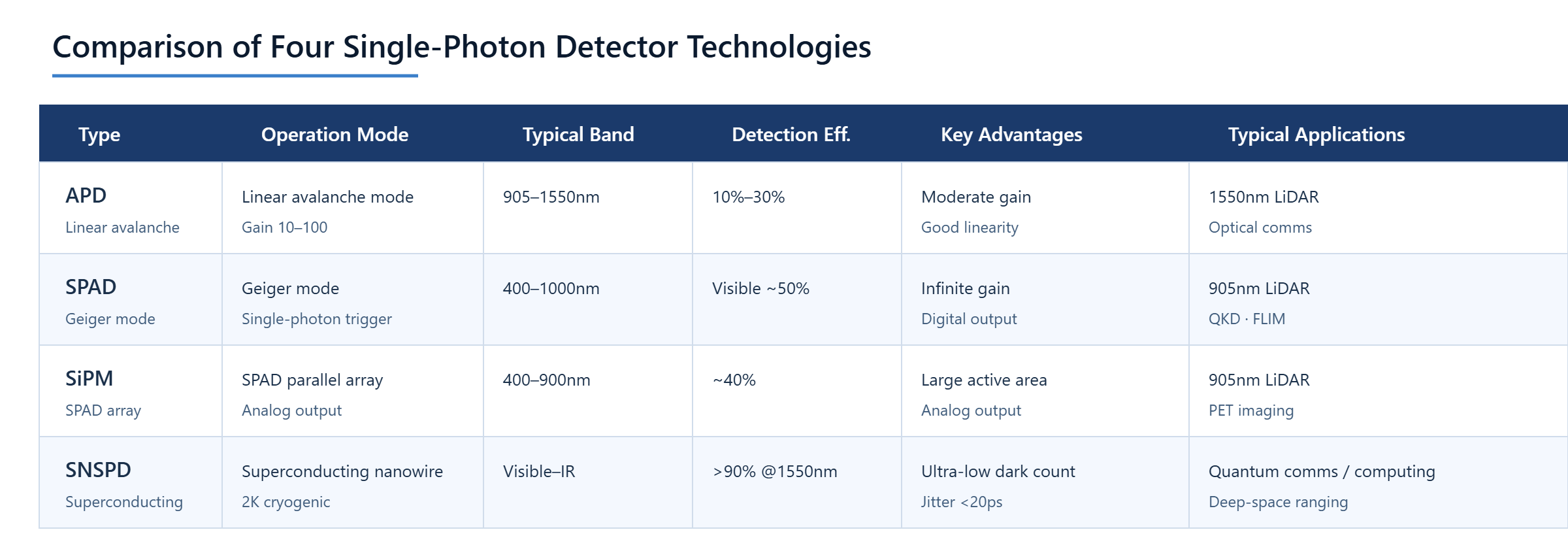
Comparison of four single-photon detector technologies (APD / SPAD / SiPM / SNSPD)
APD (Avalanche Photodiode) is the most basic generation: in linear avalanche mode it provides an internal gain of about 10–100× with good linearity. When the bias voltage exceeds the breakdown voltage, it enters Geiger mode and becomes an SPAD, where a single photon can trigger a self-sustaining avalanche and produce a saturated output pulse. SiPM consists of hundreds of micro-SPADs in parallel, providing analog output; SPAD arrays, on the other hand, output digital signals per pixel, and intensity information is obtained via histogram statistics – hence LiDAR using SPAD arrays is also called “digital LiDAR”. SNSPD, made of ultra-thin superconducting nanowires (typically NbN) operating at ~2 K, outperforms semiconductor types in PDE, dark count, and jitter, making it the detector of choice for quantum information technology.
3. 2025-2026 Domestic Breakthroughs: From Parallel to Leadership
3.1 Mass Production of 4-Channel Ultra-Low-Noise Semiconductor SPD
In October 2025, the Anhui Quantum Information Engineering Technology Research Center announced the mass production of the world’s first 4-channel ultra-low-noise semiconductor single-photon detector, based on patents from USTC and the CAS Quantum Innovation Institute. Key breakthroughs include: deep cooling (minimum operating temperature lowered from –50°C to –120°C), ultra-low dark noise (~100 Hz at 20% PDE, a 90% reduction), and high integration (volume only 1/9 of comparable single-channel products, with PDE increased from 25% to 35%). This device provides a domestically-controlled core component for quantum communication, single-photon LiDAR, fluorescence imaging, and deep-space ranging.
3.2 SNSPD System Efficiency Exceeds 90%
The team of You Lixing at the Shanghai Institute of Microsystem and Information Technology (SIMIT), CAS, achieved a detection efficiency exceeding 90% at 1550 nm using a compact closed-cycle cryocooler at 2.1 K. Previously, the record (93%) was held by NIST using WSi material; SIMIT’s achievement reaches a comparable efficiency with an engineered closed-cycle cryocooler (rather than complex dilution refrigeration), greatly enhancing practical usability. As early as 2021, the same team, in collaboration with the CAS Technical Institute of Physics and Chemistry, set a world record of 93% efficiency at communication wavelengths, laying the foundation for space-based quantum information applications.
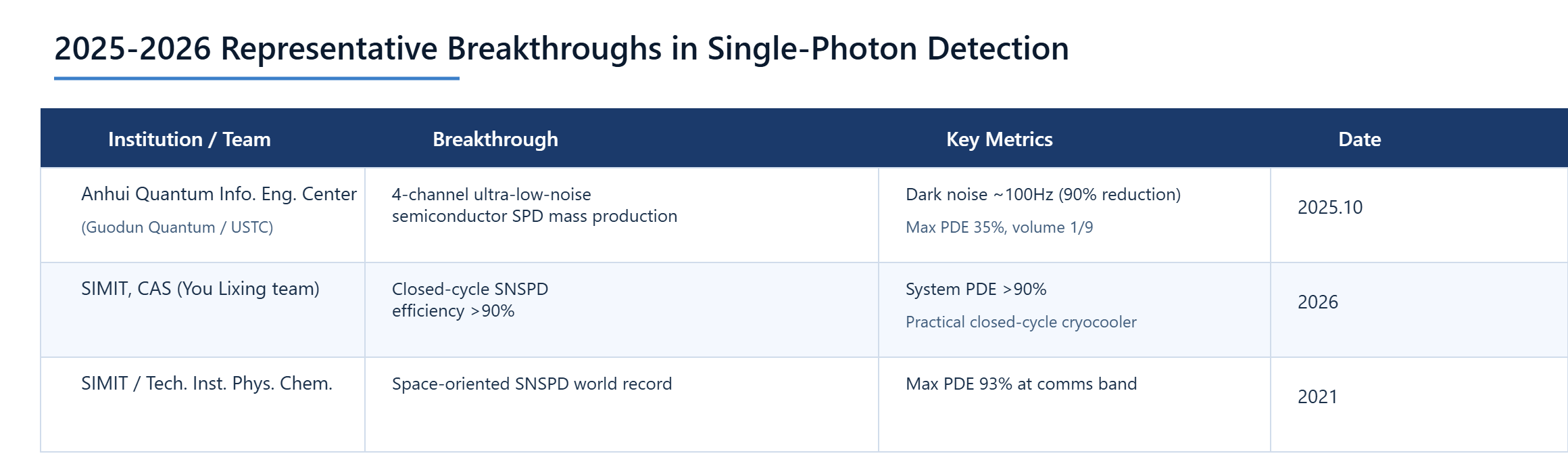
Representative breakthroughs in single-photon detection (2025-2026)
4. Application Landscape: From Quantum Key Distribution to Digital LiDAR
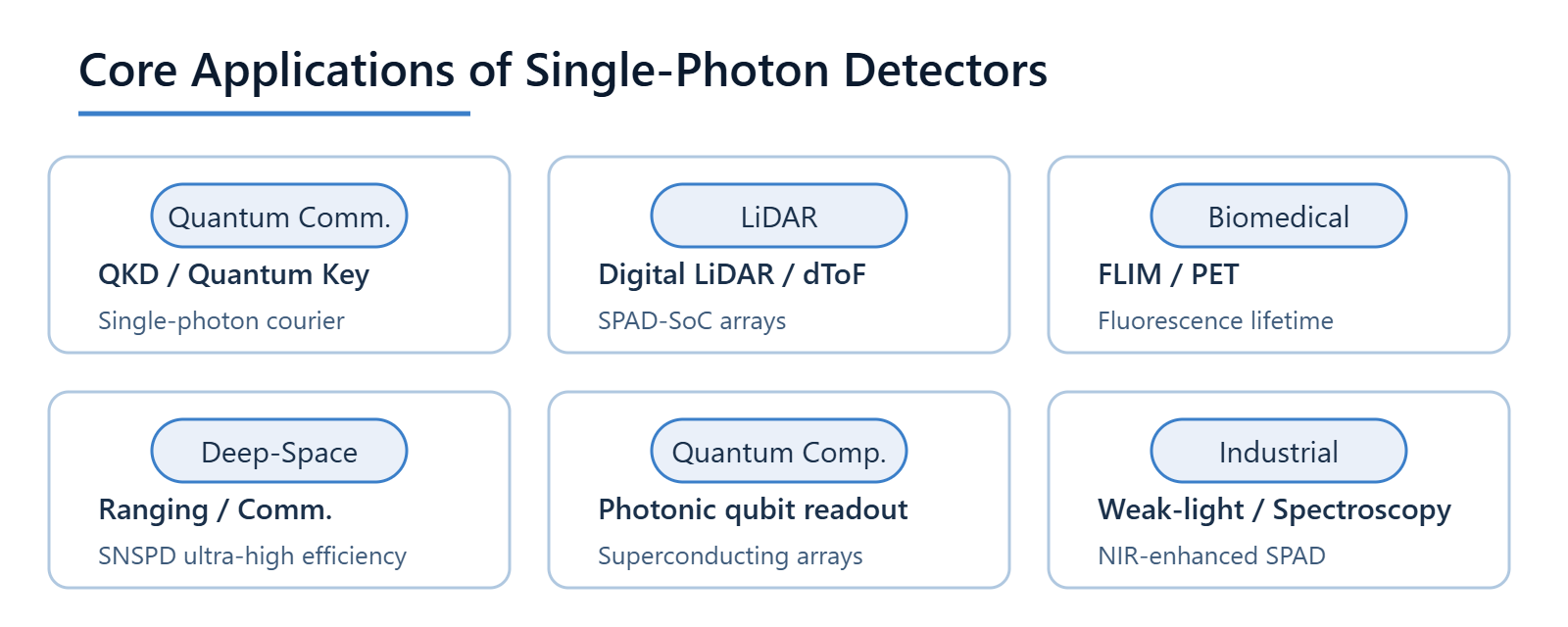
Six core application areas of single-photon detectors
4.1 Quantum Key Distribution (QKD): The “Secure Courier” of Single Photons
In quantum secure communication, the information carrier is a single photon, and any eavesdropping is revealed by the no-cloning theorem. The SPD serves as the “receiving terminal” of the QKD system, and its PDE and dark noise directly determine the distance and rate of key distribution. The domestic 4-channel deep-cooled detector is designed for such applications, while SNSPDs support hundreds-of-kilometer quantum communication backbones.
4.2 Digital LiDAR: SPAD-SoC Reconstructs the “Retina”
LiDAR is undergoing a paradigm shift from mechanical scanning to all-solid-state, and the receiving unit is evolving from analog APD/SiPM to highly integrated digital SPAD-SoC. SPAD-SoC monolithically integrates the SPAD array, readout circuitry, time-to-digital converters (TDCs), and histogram building blocks, achieving “optical-computing integration.” In 2026, SPAD-SoC using 3D stacking increases integration by ~10×; AI-assisted detection improves robustness in complex scenes by ~60%; and cost reduction makes “10k-line” solid-state flash LiDAR mass production increasingly feasible.
4.3 Biomedical and Deep-Space Exploration
In Fluorescence Lifetime Imaging (FLIM), the picosecond-level jitter of SPADs enables precise discrimination of fluorophore lifetime differences for early cancer diagnosis. In PET imaging, SiPM arrays replace traditional photomultiplier tubes due to high gain and magnetic-field compatibility. For deep-space ranging and space-based quantum information, SNSPDs’ ultra-high efficiency and extremely low dark count make them the irreplaceable “eye of the deep.”
5. Market Landscape and Industry Trends
The single-photon detector market is in rapid growth, driven by the scaling of quantum information technologies (quantum communication backbones, quantum computing prototypes) and the ramp-up of automotive LiDAR (the strong demand for dToF SPAD arrays in high-level autonomous driving). The market structure is accelerating from SiPM-dominant to SPAD-array-dominant, especially in the 905nm band.
The global landscape shows “US/Japan/Europe leading in high-end, China accelerating to catch up.” China’s advantages include: leveraging national quantum communication deployments (Beijing-Shanghai backbone, Micius satellite), domestic companies have achieved large-scale supply of semiconductor SPDs; SIMIT’s SNSPD technology is world-leading; and in LiDAR SPAD arrays, the window for domestic substitution is opening. Single-photon detectors are highly coupled with light sources, modulators, optical frequency combs, and other technologies, providing a practical path for horizontal integration of photonics product lines.
6. Summary and Outlook
The story of single-photon detectors is humanity’s long endeavor to “see the faintest light.” From the avalanche gain of Geiger-mode APDs to the ultimate sensitivity of superconducting nanowires, SPDs keep pushing the physical limits of detection and expanding the application boundaries of quantum technology, LiDAR, and biomedicine.
Looking ahead, single-photon detection will evolve along three major directions:
Array-based and on-chip integration: Moving from single-pixel to ten-thousand-pixel SPAD arrays, monolithically integrated with CMOS readout and AI processing (SPAD-SoC), supporting solid-state flash LiDAR and consumer dToF sensors.
Practicalization of superconducting detectors: SNSPDs will move from large dilution refrigerators to compact closed-cycle cryocoolers, toward spaceborne payloads and large-scale quantum computing arrays, with continuous reduction in system volume and power consumption.
Multi-band and room-temperature operation: Developing NIR-enhanced SPADs and room-temperature high-sensitivity detectors to reduce reliance on deep cooling and expand into industrial inspection and mobile applications.
When a detector can count every photon that arrives, the vast ocean of the quantum Internet will no longer be out of reach.