
1. The Essence of Spectroscopy: The "Fingerprint Identification" of Light
A spectrum is the distribution curve of polychromatic light arranged by wavelength (or frequency) after passing through a dispersive system. Every atom, molecule, and material absorbs or emits photons at specific wavelengths, forming unique spectral features – like human fingerprints, these are called "spectral fingerprints." Spectroscopy identifies these fingerprints to perform qualitative and quantitative analysis of material composition.
From Newton's prism to the modern Michelson interferometer of FTIR, spectroscopy has evolved over more than three centuries. Today, in 2026, it has grown from a purely academic analytical tool into a core technology supporting agriculture, industry, healthcare, environment, and communications.
New Classification Framework for Spectrometers (2026): A team led by Professor Liu Wenqing at the Anhui Institute of Optics and Fine Mechanics, CAS, proposed a new classification framework that divides spectrometers into "wave-like" and "particle-like" categories based on their measurement principles. This framework is expected to have a profound impact on the global spectroscopy industry.
2. Six Technology Routes: From FTIR to Quantum Dot Spectrometers
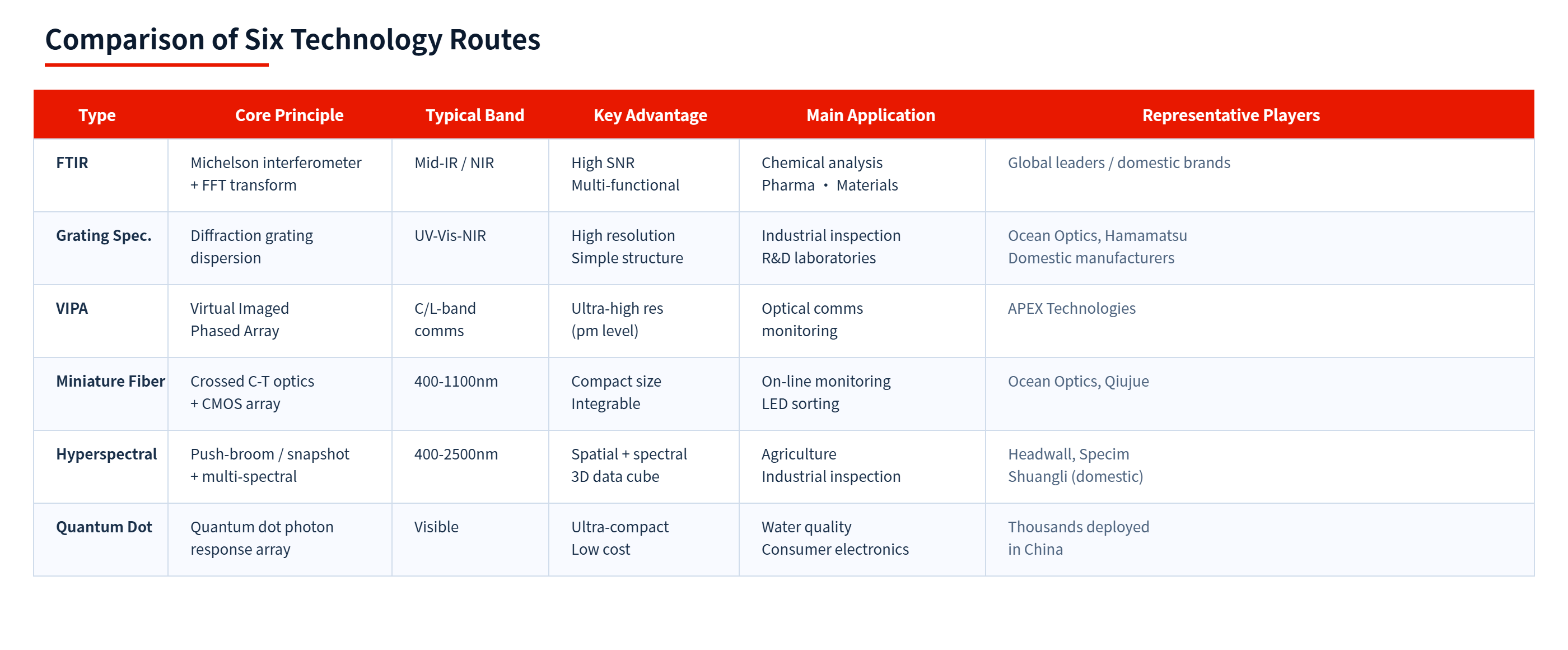
Comparison of six optical spectroscopy technology routes
FTIR is the most mature instrument in industrial analysis, with a global market size of $1.25 billion in 2023, projected to exceed $1.5 billion in 2025 at a CAGR of 6.8%. VIPA (Virtual Imaged Phased Array) achieves picometer-level resolution, 100–1000 times higher than conventional grating spectrometers. Hyperspectral imaging deeply integrates "spectrometer" and "camera" to form "spectrally resolved images" – a 3D data cube (spatial × spatial × spectral). The global hyperspectral camera market is expected to reach $189 million by 2031 at a CAGR of 15.1%.
3. Major Breakthroughs in 2025-2026
3.1 Particle-based Spectrometer: Breaking the 300-Year "Size-Performance" Dilemma
In early 2026, a Chinese research team proposed the concept of a "particle-based spectrometer," opening a new track in principle. Traditional wave-based spectrometers rely on dispersive elements like prisms and gratings, which have an inherent trade-off between size and performance. Particle-based spectrometers use novel optoelectronic materials such as quantum dots and perovskites, allowing photons to directly interact with the electronic states of the material, encoding wavelength information into electrical signals without traditional optical structures. China is already at the forefront of quantum dot spectral sensors, with thousands of units deployed in water quality monitoring, proven stable in various scenarios.
3.2 Fudan University: 2.5nm-Resolution CMOS-Compatible Miniature Spectrometer
In 2025, Professor Mei Yongfeng’s group at Fudan University published a cover paper in PNAS: a miniature computational reconstruction spectrometer with a resolution of 2.5 nm, fully CMOS-compatible. This result nearly halves the typical 5-10 nm resolution of conventional miniature spectrometers (e.g., smartphone spectral sensors) and enables low-cost mass production, paving the way for high-resolution spectral analysis in smartphones and wearables.
3.3 University of Stuttgart: 3D-Printed Micro-Spectrometer (100 μm)
A team at the University of Stuttgart used femtosecond laser direct-writing 3D printing to develop a micro-spectrometer with a volume smaller than 100×100×300 μm, mountable directly on miniature image sensors. Operating in the visible range (490-690 nm) with a resolution of 9.2 nm at 532 nm, this chip-scale device opens new possibilities for in-vivo endoscopic spectroscopy and wearable medical devices.
4. Application Landscape: From the Lab to the Field, Factory, and Operating Room
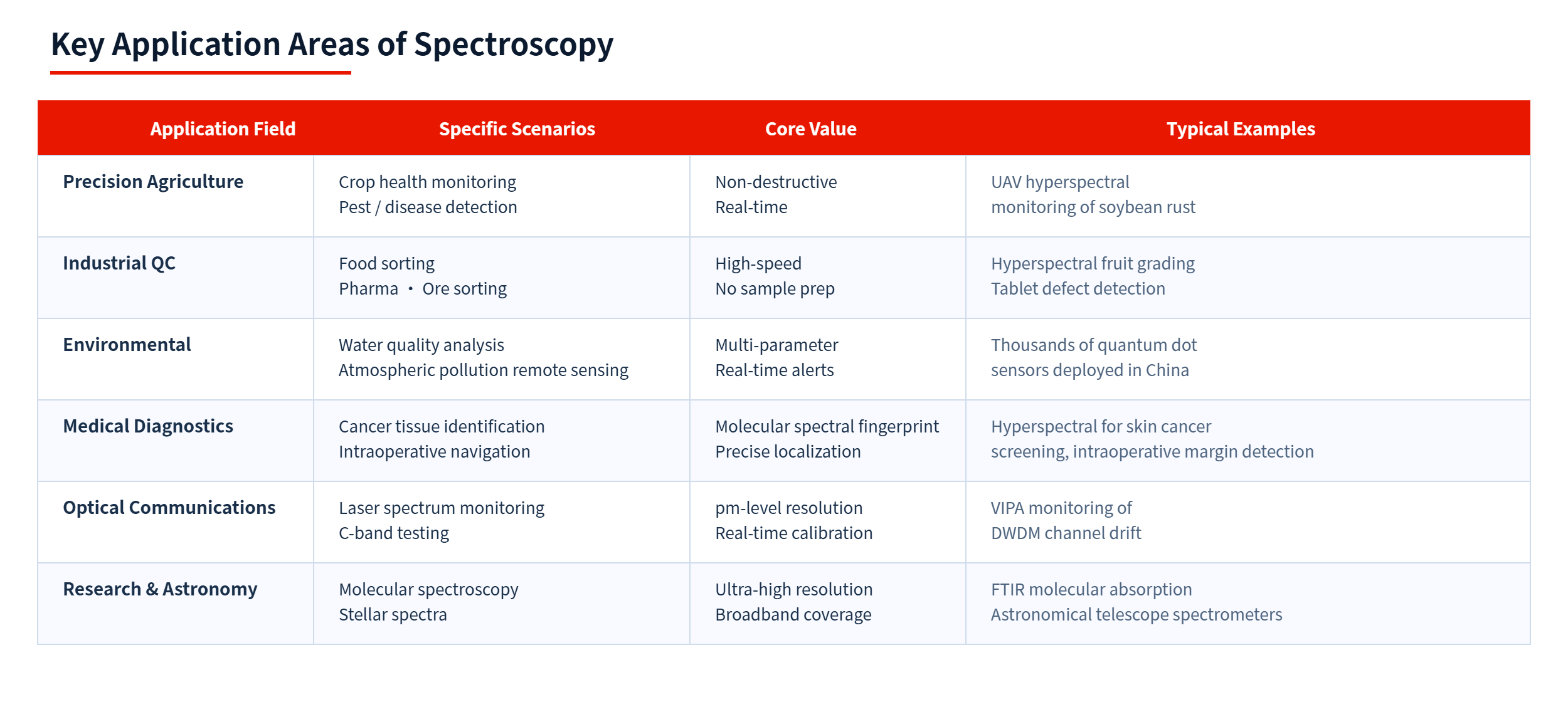
Six key application areas of spectroscopy
In agriculture, hyperspectral imaging is moving from "spaceborne" to "field-level." Industrial inspection is one of the fastest-growing applications, enabling full-volume quality inspection in food, pharma, and ore sorting. In medicine, hyperspectral imaging can differentiate normal from cancerous tissue, assisting real-time intraoperative tumor margin detection – tens of times faster than traditional frozen-section pathology.
5. Market Landscape and Domestic Progress
The global FTIR market has long been dominated by international leaders; hyperspectral is also a stronghold of overseas companies. In 2026, the combination of quantum cascade lasers (QCL) with FTIR is extending coverage from mid-IR to long-wave IR, significant for industrial gas monitoring and trace organic detection.
On the domestic front, Chinese brands have already formed alternatives in FTIR-NIR, FTIR systems, and hyperspectral imaging for research and industrial inspection. The large-scale deployment of thousands of quantum dot spectrometers marks a milestone where China's advantage in quantum dot materials extends to instrumentation. Spectroscopy is closely synergistic with passive optical components (gratings, prisms, interferometers), tunable lasers, optical coatings, and integrated photonics.
6. Summary and Outlook
The evolution of spectroscopy is humanity's continuous quest to "see the world more finely." From Newton's prism to quantum dot spectral sensors, from bulky FTIR lab instruments to miniature spectral chips in smartphones, spectroscopy is advancing along the trajectory of "higher resolution, smaller size, lower cost."
Three major trends will profoundly shape the future of spectroscopy:
AI Integration: Combined with deep learning, spectrometers will evolve from "measurement tools" to "analytical terminals" that automatically identify unknown compounds and predict concentrations. Fudan's CMOS-compatible miniature spectrometer has already demonstrated the immense potential of AI+spectroscopy.
Miniaturization and Embedding: Chip-scale spectral sensors (quantum dots, perovskites, nanowires) are pushing spectral analysis from the lab to the field and consumer electronics – skin analysis via smartphones and food inspection apps are already emerging.
Multi-technology Fusion: Multi-modal combination of FTIR+NIR+XRF will enable one-shot full-spectrum analysis of complex samples; hyperspectral combined with edge computing and 5G will build real-time on-site IoT sensing networks.
When a spectral "fingerprint" can be read in milliseconds by a single chip, and when every beam of light reveals its composition without disguise – spectroscopy is releasing precise analysis from the laboratory walls into the front lines of countless industries.